TIWN Sep 18, 2026
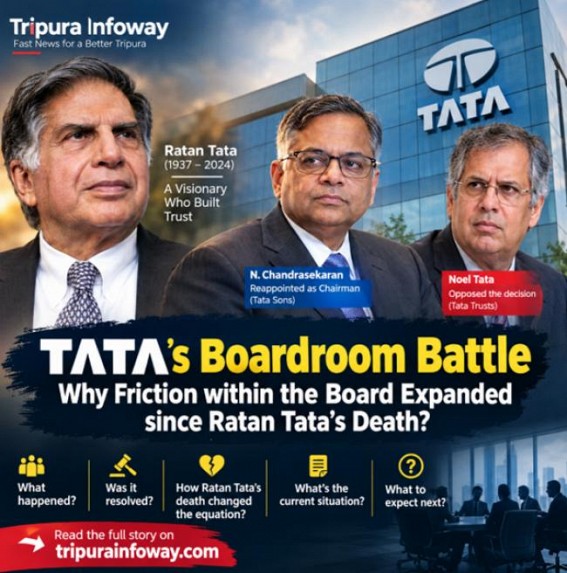
NEW DELHI, Sep 18 (TIWN): The Tata Group is facing one of its most significant internal governance disputes in years.
At the centre of the latest confrontation is a question that appears to have been settled several times: Should N. Chandrasekaran continue as chairman of Tata Sons?
On September 17, 2026, the Tata Sons board voted by majority to reappoint Chandrasekaran for another five-year term. He had previously announced that he would not seek another term after his current tenure ends in February 2027.
But the decision immediately triggered another dispute.
Noel Tata, chairman of Tata Trusts, voted against the reappointment. Tata Trusts subsequently said the board's decision was legally invalid, arguing that the Tata Sons Articles of Association require the support of the Trusts' nominee directors for the appointment or reappointment of the chairman.
So, while Chandrasekaran has been reappointed by the board, the disagreement over whether that decision is legally valid has not been settled.
What exactly happened?
The story goes back several months.
In September 2025, Tata Sons had agreed in principle to give Chandrasekaran another five-year term. Tata Trusts had also earlier expressed appreciation for his leadership and supported his continuation.
But when the formal decision came up in February 2026, the board did not reach the required consensus. The issue was discussed again in May and June but remained unresolved.
On August 12, Chandrasekaran announced that he would not offer himself for another term.
That appeared to end the uncertainty.
Tata Trusts accepted his decision and suggested that the process of finding a successor should begin.
Then the story changed again.
On September 3, the Tata Sons Nomination and Remuneration Committee unanimously asked Chandrasekaran to reconsider. The committee cited his contribution to the group and what it described as the larger interests of Tata Group.
Chandrasekaran agreed to reconsider.
On September 17, the Tata Sons board voted to reappoint him for another five years. Noel Tata was the lone director opposing the proposal, according to Tata Sons' reported board composition and subsequent statements.
Why did the disagreement become so serious after Ratan Tata's death?
Ratan Tata died on October 9, 2024.
Two days later, Noel Tata was unanimously appointed chairman of Tata Trusts. The Trusts collectively own around 66% of Tata Sons, giving them enormous influence over the holding company and, indirectly, the wider Tata Group.
But Ratan Tata had occupied a unique position in the Tata system.
He was not simply chairman of Tata Sons or a trustee. He was also the central figure who had helped maintain consensus between the charitable trusts and the professional management of Tata Group.
After his death, that informal authority disappeared.
What followed was a series of disagreements involving:
-
Tata Trusts' representation on the Tata Sons board
-
governance and information-sharing
-
succession
-
Tata Sons' future ownership structure
-
the proposed exit of the Shapoorji Pallonji group
-
losses and capital allocation in some newer businesses
-
and, increasingly, whether Tata Sons should remain private or move toward a stock-market listing.
So it would be too simple to say that Ratan Tata's death "caused" the current dispute. Rather, his death removed a powerful consensus-building figure at a time when several difficult strategic questions were already emerging.
The biggest issue now: Tata Sons and a possible IPO
This may be even more important than Chandrasekaran's chairmanship.
Tata Sons has been classified by the Reserve Bank of India as an upper-layer NBFC, a classification that carries enhanced regulatory requirements, including a listing requirement under applicable rules.
Tata Sons had sought to avoid that requirement, but the RBI recently rejected its application to surrender its NBFC registration.
The Tata Sons board has now said it will initiate steps to comply with applicable RBI guidelines and seek guidance from the RBI, Tata Trusts and other stakeholders.
That is where the interests of Tata Sons and Tata Trusts appear particularly difficult to reconcile.
Tata Trusts has publicly opposed the idea of a Tata Sons listing, arguing that the Tata model is built around charitable ownership. Reuters reported that the Trusts believe a listing could fundamentally alter that structure.
A listing could also change the balance of influence around Tata Sons because the company would become subject to public-market scrutiny and potentially a different shareholder structure.
So, is the battle over?
No—not completely.
There are actually two separate questions.
Question one: Who does Tata Sons' board want as chairman?
The answer, following the September 17 vote, is N. Chandrasekaran for another five years.
Question two: Does the board have the legal authority to make that appointment without the required Trust nominee support?
That remains disputed.
Tata Trusts says the answer is no and has called the resolution a "legal nullity". It has also said it will continue with a successor-selection process in accordance with the Articles of Association.
Tata Sons, meanwhile, has proceeded with the board's resolution and said it will seek guidance from the RBI, Tata Trusts and other stakeholders regarding compliance.
In other words, the boardroom vote has happened, but the underlying governance dispute has not disappeared.
What could happen next?
The immediate focus is likely to be on three areas.
1. The legal validity of Chandrasekaran's reappointment
Tata Trusts has already challenged the basis of the board decision. The exact interpretation of Tata Sons' Articles of Association could therefore become extremely important.
2. Tata Sons' listing question
The RBI's position has made the issue much harder to postpone. Tata Sons now says it will take steps toward regulatory compliance.
That could bring Tata Trusts and Tata Sons into further disagreement because the Trusts have publicly opposed a listing.
3. Who ultimately controls Tata Sons?
This is the deeper question underneath the current fight.
The Tata structure is unusual: professional managers run a huge commercial group, while charitable trusts hold the majority ownership of the parent company.
Ratan Tata's era was characterised by a strong working consensus between these two sides.
After his death, disagreements have made that relationship more visible and more contested. Business Standard described the current situation as a breakdown of the informal consensus that had helped govern the Tata system.
The bigger picture
The current episode is therefore not simply a fight over one chairman.
It is a much larger debate about the future structure of the Tata Group:
Who should have the final say—the professional board of Tata Sons, or the charitable trusts that own the majority of Tata Sons?
For now, Chandrasekaran has the backing of the Tata Sons board.
But Noel Tata and Tata Trusts have made it clear that they do not accept the latest decision as legally settled.
That means the next chapter could involve legal interpretation, regulatory discussions, the Tata Sons listing question and potentially another attempt to find a compromise between the two sides.
The most important point for the public is this: the Tata Group is not facing an immediate operational breakdown. The dispute is primarily about governance, ownership, leadership and the future structure of Tata Sons.
- Tata’s Boardroom Battle: Why Ratan Tata’s Death Changed the Equation
- Why Is Apple Making iPhone 18 Pro in India and Flying It to America? The Bigger Strategy Behind ‘Made in India’
- Foreign Investors Withdraw Nearly Rs. 3,000 Crore From Indian Equities
- Crude Oil Crosses $100, Raising Pressure on India's Economy
- Indian Stock Market Faces Cautious Recovery After Sharp Sell-Off
Special Articles
 Sanjay Majumder
 Anirban Mitra