
TIWN Sep 29, 2026
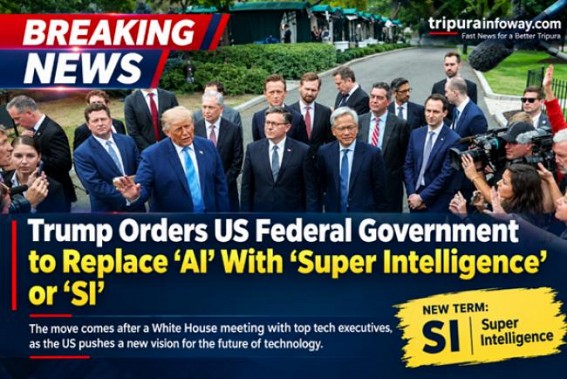
NEW YORK, Sep 29 (TIWN): The name Artificial Intelligence itself has its roots in the United States. The term was formally introduced in connection with a proposal written in 1955 for a workshop at Dartmouth College, where a group of scientists set out to explore whether aspects of human intelligence could be reproduced by machines. The Dartmouth Summer Research Project on Artificial Intelligence was held in 1956 and is widely regarded as the event that helped establish AI as a distinct field of research.
The term was formally introduced in connection with a proposal written in 1955 for a workshop at Dartmouth College, where a group of scientists set out to explore whether aspects of human intelligence could be reproduced by machines. The Dartmouth Summer Research Project on Artificial Intelligence was held in 1956 and is widely regarded as the event that helped establish AI as a distinct field of research.
Nearly seven decades later, as the world races to develop increasingly advanced artificial intelligence, the United States has moved to give the technology a new official name.
US President Donald Trump said on September 29 that Artificial Intelligence would be referred to as “Super Intelligence”, or “SI”, in the United States.
Trump made the remarks after a White House meeting and luncheon with some of the world's leading technology executives, including Nvidia CEO Jensen Huang, OpenAI President Greg Brockman, Anthropic CEO Dario Amodei, Meta CEO Mark Zuckerberg, Google CEO Sundar Pichai and Elon Musk, among others.
Speaking at an event connected with the launch of the US government's new America.gov platform, Trump said the technology was no longer appropriately described as “artificial.”
“This is extreme intelligence. It’s superior intelligence... the word super is the best word of all and it’s the simplest. And so we’re going to be naming it SI, super intelligence.”
Trump also said that an executive order would formally direct the change in terminology for federal agencies.
“We’re going to be renaming it super intelligence, officially renaming it,” Trump said.
What about AI regulation?
The announcement came amid an ongoing debate in the US over how rapidly developing AI should be regulated.
After the White House meeting, Trump was asked about whether the technology industry needed stronger government guardrails. He pointed instead to self-regulation by technology companies, saying:
“There’s a belief that there should be tremendous self-regulation.”
Trump added that existing institutions, including the Department of Justice and the FBI, could intervene if companies or individuals crossed legal boundaries.
The White House meeting also produced a voluntary agreement involving major AI companies. According to Reuters, participating companies committed to developing “robust internal controls”, working with independent auditors and taking steps to prevent their AI systems from accessing or hacking technical systems in unintended ways.
Trump described the agreement as being similar to a constitution and said it would provide a form of protection while allowing the industry to continue expanding.
US-China AI race
Trump also connected the development of advanced AI with America's technological competition with China.
He said the United States was currently leading and argued that sharing sensitive AI technology with China could allow Beijing to gain access to American technological knowledge.
“Whoever wins super intelligence wins,” Trump said, adding that he wanted the United States to maintain its lead over China.
Trump further argued that the development of the technology should not be slowed by excessive regulation.
“We don’t want to stifle growth. At the same time, we want people to behave honestly. We want them to be trustworthy.”
A broader debate over AI safety
The terminology change comes at a time when the future of AI regulation is being debated both in Washington and internationally.
Earlier this month, OpenAI CEO Sam Altman and Anthropic CEO Dario Amodei told the United Nations Security Council that governments would need to play a role in managing the risks associated with increasingly powerful AI systems. Altman warned that humanity could potentially “lose control of the future of AI,” while Amodei described poorly managed AI as a potential risk to humanity.
At the same time, the Trump administration has rejected calls for international bodies to impose centralized global control over AI. Its approach has instead emphasized rapid technological development, US leadership and industry-led safety measures.
For now, “Artificial Intelligence” remains the established scientific and global term, while Trump's administration is moving toward using “Super Intelligence” or “SI” in US government terminology. The announcement therefore represents not just a change in wording, but another indication of how quickly the political and technological debate around advanced AI is evolving.
- Co-Pilot Allegedly Stabs Captain Mid-Flight, Plane Makes Emergency Landing in Saudi Arabia
- ‘Artificial Intelligence’ Renamed as ‘Super Intelligence’ in the US
- Australia Launches Urgent Review After OpenAI AI Agent Breaches Medicare Portal
- China Reduces Troop Presence Along LAC as India-China Relations Improve: Report
- Indonesia Ferry Capsizes in Java Sea, 129 Missing
Special Articles
 Sanjay Majumder
 Anirban Mitra