
TIWN
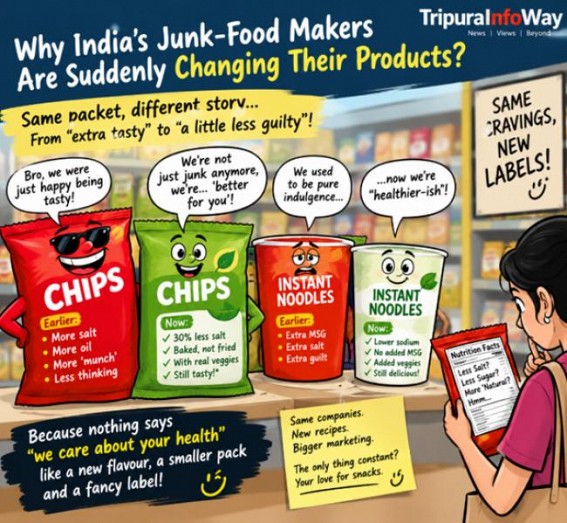
From “finger-licking good” to “please check the ingredients” — India’s junk-food industry appears to be having a small identity crisis.
For years, India’s packaged-food shelves have been flooded with chips, instant noodles, biscuits, sugary drinks and ready-to-eat snacks promising happiness in a colourful packet. But now, something interesting is happening: junk-food makers are quietly changing their recipes, ingredients, portions and packaging.
And no, it is probably not because the industry suddenly discovered yoga.
The biggest reason is growing consumer awareness. Indians are increasingly reading food labels, questioning excessive salt, sugar, saturated fat and additives, and paying more attention to what goes into their favourite snacks. Parents are also becoming more cautious about what ends up in their children’s lunchboxes.
That change in attitude is forcing food companies to respond.
Some manufacturers are reducing sugar or salt, experimenting with alternative ingredients, changing serving sizes and introducing products marketed as “better,” “lighter,” “baked,” “high-protein” or “made with natural ingredients.”
In other words, the packet may still look like junk food — but now it may arrive wearing a slightly healthier suit.
There is also growing regulatory and public pressure on food companies to provide clearer nutritional information and make marketing claims more transparent. As scrutiny increases, brands have a strong incentive to reformulate products rather than wait for consumers or regulators to do the complaining for them.
But there is another powerful force: money.
The Indian health-and-wellness market is growing, and food companies do not want to be left behind. Consumers who once happily bought a giant packet of chips are now asking questions like, “How much protein does this have?” The industry has heard them — and is rushing to put “protein” somewhere on the packet.
The result is a fascinating transformation.
The same companies that once sold indulgence as a lifestyle are now talking about balance, nutrition and responsible consumption. The humble snack has apparently entered its “personal development phase.”
But consumers should remain careful. A product being labelled “baked,” “natural,” “multigrain” or “high-protein” does not automatically make it healthy. Marketing language can be clever, while nutrition labels are usually much less glamorous.
The real test is simple: turn the packet around and read the ingredients and nutrition table.
India’s junk-food makers may be changing their products — but consumers are changing even faster.
And perhaps that is the biggest reason the industry is suddenly discovering that healthy food is not just a trend. It is becoming a business necessity.
Special Articles
 Sanjay Majumder
 Anirban Mitra