
Make this your homepage
World News
Home > World News
Iran Central Bank Governor Resigns Amid Protests Against Collapsing Economy
TIWN Dec 29, 2025
Iran Central Bank Governor Resigns Amid Protests Against Collapsing Economy
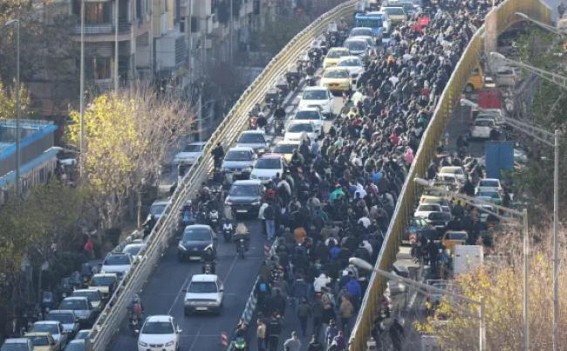
PHOTO : Iran Central Bank Governor Resigns Amid Protests Against Collapsing Economy.

Widespread protests have erupted in Iran amid a deepening economic crisis, culminating in the resignation of Central Bank Governor Mohammad Reza Farzin. The demonstrations, driven by the dramatic devaluation of the Iranian rial and soaring inflation, mark a significant escalation in public discontent but remain smaller in scale compared to the nationwide uprising in 2022 following the death of Mahsa Amini in police custody due to alleged mistreatment.

The protests began on December 28, 2025, initially in Tehran's major mobile phone markets, where merchants and shopkeepers closed their businesses and chanted anti-government slogans. By December 29, the unrest had spread to key commercial areas in the capital, including Saadi Street in downtown Tehran, the Shush neighborhood near the Grand Bazaar, Jomhouri Street near the Aladdin mobile phone complex, Ferdowsi Street (a foreign exchange hub), Hafez Bridge, and the Charsou Shopping Complex. Parallel rallies were reported in other cities, including Isfahan in central Iran, Shiraz in the south, Mashhad in the northeast, and Karaj near Tehran.

Riot police responded by firing tear gas and setting up barriers to disperse the crowds, with some demonstrations lasting for hours before being cleared. Videos from the scene showed protesters chanting against economic mismanagement, with some invoking references to the pre-revolutionary era under the Shah. No official casualty figures have been released, though the Islamic Revolutionary Guard Corps (IRGC) issued warnings against "sedition," and the judiciary promised action against those disrupting markets or hoarding currency.

The economic outrage stems from the rial's plunge to historic lows in the open market, briefly hitting 1.42 million rials per U.S. dollar on December 28 before settling around 1.38 million to 1.44 million on December 29. This devaluation has fueled annual inflation of 42.2% and a 72% surge in food prices, exacerbating dire living conditions for many Iranians. The crisis is attributed to longstanding U.S. sanctions reimposed after the 2018 withdrawal from the 2015 nuclear deal, UN "snapback" measures in September 2025 freezing Iranian assets, and recent geopolitical tensions, including a 12-day war with Israel in June 2025.

Farzin, appointed under the previous administration of President Ebrahim Raisi, submitted his resignation on December 29, which was accepted by President Masoud Pezeshkian. Abdolnaser Hemmati, a former economy minister and central bank governor, has been appointed as his replacement in an effort to stabilize the market. Despite some conflicting reports denying the resignation, official confirmations from the president's office indicate the change has proceeded.

These events echo the historical role of Tehran's merchants, who were instrumental in the 1979 Islamic Revolution that ousted the Pahlavi monarchy under Shah Mohammad Reza Pahlavi and established the Islamic Republic. While the current protests are economically focused and have not yet reached the breadth of the 2022 demonstrations, they highlight growing public frustration with the government's handling of the economy amid international isolation.

Add your Comment
Comments (0)

Special Articles

Sanjay Majumder Sanjay Majumder

Anirban Mitra Anirban Mitra